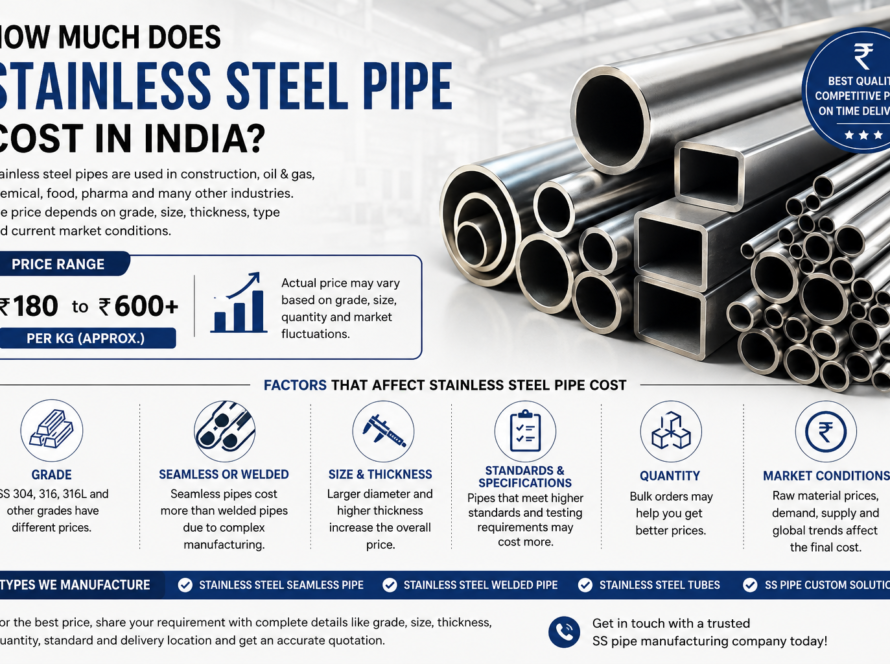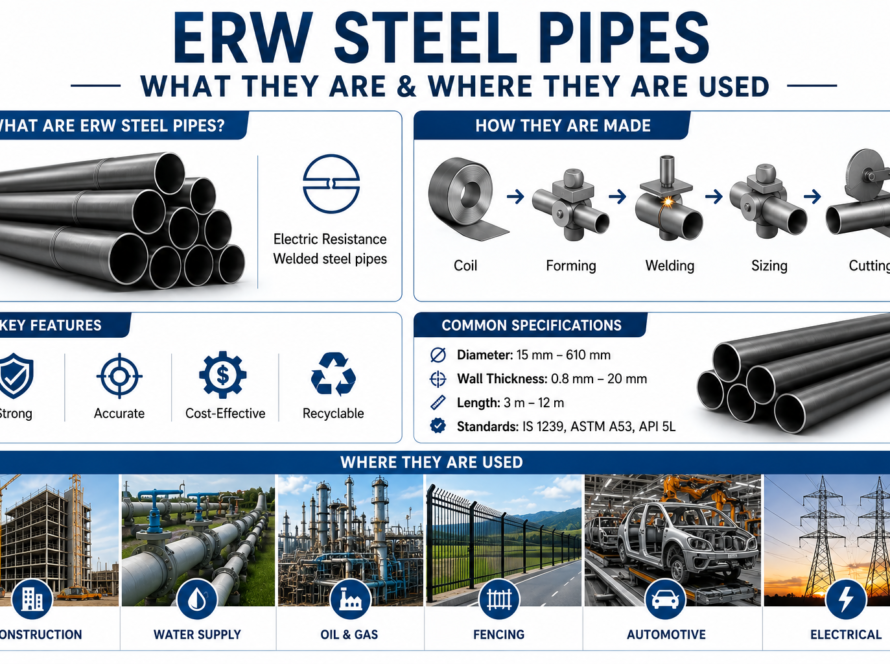

Stainless steel pipes are widely used in industries such as oil and gas, chemical processing, food and beverage, pharmaceuticals, construction, power generation, and water treatment. Their popularity comes from excellent corrosion resistance, strength, durability, and ability to perform reliably in demanding environments.
The manufacturing process plays an important role in determining a pipe’s quality, dimensions, surface finish, and mechanical properties. Depending on the application, stainless steel pipes can be manufactured as welded pipes or seamless pipes.
This article explains the stainless steel pipe manufacturing process step by step and highlights the key differences between seamless and welded production.
What Is a Stainless Steel Pipe?
A stainless steel pipe is a hollow cylindrical product manufactured from stainless steel alloys containing chromium and other alloying elements. Chromium helps create a protective oxide layer on the surface, giving stainless steel its characteristic resistance to corrosion.
Common stainless steel grades used for pipes and tubes include 304, 304L, 316, 316L, 321, and 310. The appropriate grade, size, wall thickness, and manufacturing method depend on the intended operating conditions.
Stainless Steel Pipe Manufacturing Process
The exact Steel Pipe Manufacturing process varies depending on whether the final product is seamless or welded. However, manufacturers generally follow several carefully controlled stages to achieve the required dimensions, strength, surface quality, and performance.
1. Raw Material Selection
Manufacturing begins with the selection of suitable stainless steel raw material. For seamless pipes, manufacturers typically start with solid round billets. Welded pipes are generally produced from stainless steel coils, strips, or plates.
The chemical composition of the material is important because it affects corrosion resistance, mechanical strength, weldability, and temperature performance.
2. Heating and Forming
For seamless production, a solid stainless steel billet is heated to a suitable forming temperature. The heated billet is then pierced through its center to create a hollow shell.
The hollow section is subsequently rolled, elongated, or drawn until the required diameter and wall thickness are achieved.
This process produces an ss seamless tube without a longitudinal welded seam, making seamless products suitable for many demanding pressure and temperature applications when specified by the relevant design standard.
3. Welded Pipe Formation
The manufacturing method for welded stainless steel pipes is different. Stainless steel strip, coil, or plate is first formed into a cylindrical shape using forming equipment.
The edges are then joined through an appropriate welding process. Depending on the product specification and application, manufacturers may use processes such as TIG welding, laser welding, or other suitable welding technologies.
After welding, the weld area may undergo additional processing to achieve the required dimensional and surface characteristics.
4. Heat Treatment
Controlled heat treatment can help restore the desired metallurgical structure, relieve stresses from manufacturing, and achieve specified mechanical and corrosion-resistance properties.
5. Sizing and Straightening
After forming and heat treatment, the pipe is processed to meet dimensional requirements.
Sizing operations help achieve the specified outside diameter and wall thickness tolerances. Straightening equipment is then used to correct bends or distortions that may have developed during earlier manufacturing stages.
Accurate dimensional control is particularly important for products intended for precision engineering and industrial piping systems.
6. Pickling and Surface Treatment
During manufacturing and heat treatment, oxide scale can form on the stainless steel surface. Pickling may be used to remove heat tint, scale, and surface contamination.
Depending on customer requirements, additional surface-finishing operations can also be performed. The desired finish varies according to the application, particularly for industries where cleanliness and surface condition are important.
7. Cutting to the Required Length
The manufactured pipes and tubes are cut to specified lengths. Standard commercial lengths may be supplied, or pipes can be produced and cut according to customer requirements.
Ends may also receive additional preparation, such as beveling, depending on the intended joining method and specification.
8. Inspection and Testing
Quality control is a critical part of ss pipe manufacturing. Manufacturers inspect finished products to verify that they comply with the applicable specifications, standards, and customer requirements.
Depending on the product and specification, testing may include dimensional inspection, visual inspection, mechanical testing, hydrostatic testing, eddy-current testing, ultrasonic testing, chemical composition verification, and other nondestructive examination methods.
The exact tests performed depend on the applicable standard and service requirements.
9. Marking, Packaging, and Dispatch
Once the pipes pass the required inspections, they are marked with relevant identification information. This can include the manufacturer’s identification, material grade, size, specification, heat number, or other traceability information required by the applicable standard or purchase order.
Finished pipes are then bundled or packaged appropriately to protect them during handling, storage, and transportation.
Applications of Stainless Steel Pipes
Because stainless steel combines corrosion resistance with strong mechanical performance, stainless steel pipes and tubes are used in a wide range of industries, including:
- Oil and gas processing
- Chemical and petrochemical plants
- Food and beverage processing
- Pharmaceutical manufacturing
- Power generation
- Water and wastewater treatment
- Heat exchangers
- Automotive equipment
- Construction and architecture
- Marine and offshore systems
Each application may require a particular stainless steel grade, manufacturing method, dimensional tolerance, surface finish, and testing standard.
Why Manufacturing Quality Matters
The reliability of stainless steel piping depends heavily on manufacturing control. Material selection, forming, welding where applicable, heat treatment, dimensional accuracy, surface treatment, and inspection all influence the performance of the finished product.
A well-controlled manufacturing process helps ensure consistent dimensions, traceability, mechanical properties, corrosion performance, and compliance with the required industry specifications.
For buyers, it is therefore important to consider not only the stainless steel grade but also the manufacturing method, applicable standard, inspection requirements, and intended service conditions.
Conclusion
Stainless steel pipe manufacturing is a carefully controlled process that transforms stainless steel billets, coils, strips, or plates into finished piping products. Seamless production generally involves heating, piercing, rolling or drawing, heat treatment, sizing, finishing, and testing. Welded production involves forming flat stainless steel material into a tubular shape, welding the joint, and completing the necessary finishing and inspection processes.
Understanding how stainless steel pipes are manufactured can help engineers, buyers, and project managers select suitable products for their applications. Whether choosing seamless or welded material, quality manufacturing and compliance with the appropriate specifications are essential for reliable long-term performance.